Figures from the Australian Bureau of Statistics show that the proportion of people moving jobs over the past year has fallen to its lowest level on record.
For Republic Resumes in Adelaide, it has been a busy year although enquiries have slowed since the middle of July.
The ABS states around 1 million people changed jobs in the past 12 months, or 7.2 per cent of the workforce. That’s the lowest so-called “mobility rate” since figures were first collated during the days of black-and-white television.
Job mobility recently peaked in 2022 and 2023 as people were freed from COVID restrictions. During that period, the national jobless rate fell to 3.5 per cent.
Unemployment is currently 4.4 per cent – really about 7 per cent – and there has been a slowdown in job creation over the past 12 months.
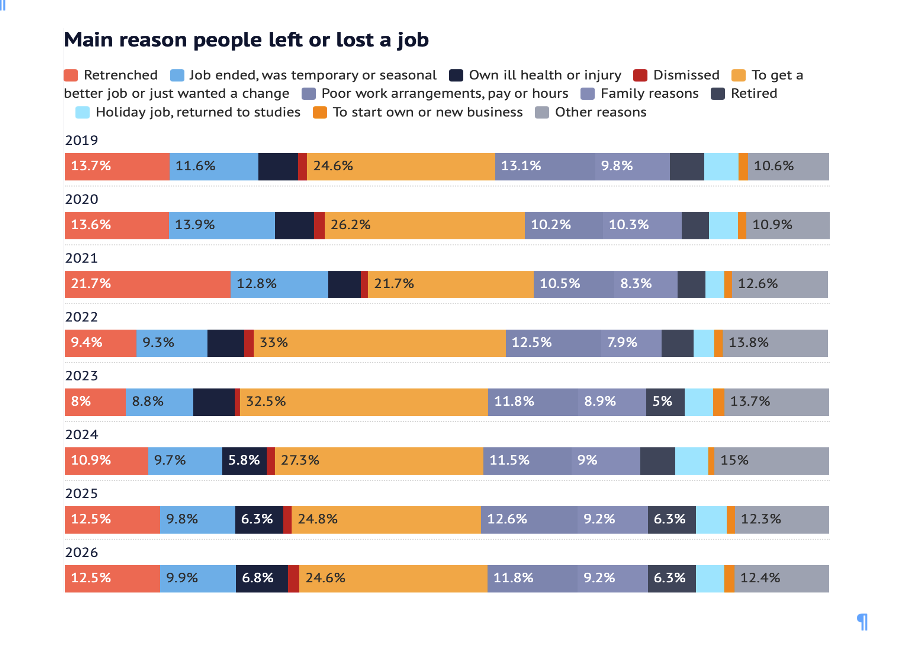
According to the ABS, the proportion of people who left a job for a better position soared to one-in-three during the post-COVID period. But this year, it had dropped to about 25 per cent.
Measures of forced job movement, such as retrenchment, are relatively stable, suggesting business conditions are not a key factor in people making a career switch.
Retirement, and ill health are also growing as reasons for job movement.
The same figures show it is people in their prime working years – between 25 and 64 – who are reticent about leaving their job for another.
Some workers are acting as though the nation is in a recession and are reluctant to take risks even when it could lead to higher pay or promotion.
Post-pandemic, more than 21 per cent of workers had been in their job for less than a year. That’s fallen to 16.4 per cent. Fifty-five per cent of people have worked with their current employer for between 1 and 10 years.